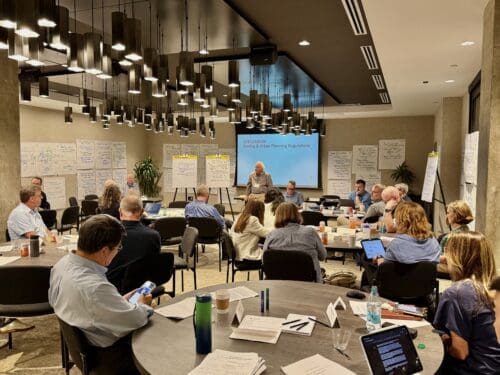
ECL’s recent Beyond Disruption summit featured an exploration of the disruptions being experienced by the engineering community, the impact of these disruptions, and the responses needed from the engineering community. This “Voices from ECL” series will feature interviews with several of the attendees at the summit.
Part 4
Rochelle Grayson is the founder of Mosaic Accelerator and co-founder of Circles of AI. She emphasized that with the rapid acceleration of AI, it is critical that AI is integrated into engineering systems in ways that retain the judgment of engineers. Rochelle stated that incorporating emerging technologies into engineering is not new and that our traditional sense of cautious skepticism will be an advantage as we incorporate AI.
Rochelle also offered her thoughts on engineering education, highlighting the difficulty of preparing students for a future that we do not understand. She emphasized the importance of critical thinking skills and human connection skills as supplements to traditional problem-solving skills. She stressed the importance of highlighting the whole package of what it means to be an engineer beyond just the technical side.
Finally, Rochelle noted that the engineering community can enhance its public reputation and public presence by developing communication skills that incorporate story telling.
The full interview with Rochelle is available at this link.
Part 3
Dr. Jenna Carpenter is Founding Dean of Engineering at Campbell University and a Past President of ASEE. She outlined the major challenges facing higher education.
- Declining population, declining interest in college, and declining enrollment, all of which are impacting the ability to attract students and threatening the financial model of universities.
- Attracting a broader spectrum of the population of potential students into engineering.
- Undermining of federal funding for research which will ultimately impact innovation.
- Fewer graduate students due to the crackdown on immigration.
- Concerns around the best uses of AI in education.
Dr. Carpenter sees an opportunity for leadership from the engineering community as the voice of reason around scientific issues. The engineering community will need to step up to capitalize on this opportunity and will need to overcome the negative influences of social media.
The full interview with Dr. Carpenter is available at this link.
Part 2
Melyssa Hartzell is a Principal at Martin/Martin Inc. in Lakewood, CO and has participated in several ECL summits. Melyssa highlighted…
- Talent and workforce challenges in the engineering community that are creating competition for candidates and an accelerated career path that sometimes sacrifices knowledge transfer between generations.
- Positive aspects of disruption, particularly the opportunity for the engineering community to shift to a leadership role on important issues such as policy and funding.
- ECL’s approach that fosters broad, system-wide thinking as opposed to the normal project focus of day-to-day work.
The full interview with Melyssa is available at this link.
Part 1
Jerry Buckwalter was formerly the Chief Innovation Officer at ASCE and now serves as International Director of Innovation for the Atlas Initiative for Resilient Infrastructure. Highlights from Jerry’s thoughts included…
- AI as a key disruptor.
- Lack of agility in the engineering community that hampers our ability to deal with change.
- Need for engineers to “broaden their aperture” as problem solvers.
- Stepping up to our traditional role as stewards of technology with new technologies like AI.
- Recognizing the leadership opportunity to tackle bigger issues where our voice has been missing.
- Learning to communicate in different ways, incorporating “story telling.”
Jerry also highlighted how ECL’s approach to the future of engineering offers a different thought process, one that is focused on questioning whether the things we have always done are the right thing or can be done in a different way.