
“The United States will not be able to respond to climate change, drive better economic outcomes, or deliver broader measures of social equality if the physical world remains underdeveloped…. American governance is stronger if it can demonstrate that it has a political system capable of delivering essential services to its people, including safe public streets, functioning mass transit, and plentiful housing. For various American ideals to be fully realized, the country will need to recover its ethos of building…”
Dan Wang, Breakneck
“Selfishness beats altruism within groups. Altruistic groups beat selfish groups. Everything else is commentary.”
David Sloane Wilson and Edward (E.O.) Wilson
In his recent book, Breakneck, author Dan Wang highlights the differences between China, which he characterizes as an engineering state, and the United States, which he characterizes as a lawyerly society. As the quote above illustrates, the United States cannot address the engineering challenges of the 21st century unless we can shift away from our recent history as a lawyerly society to one that is able to build the infrastructure that society requires.
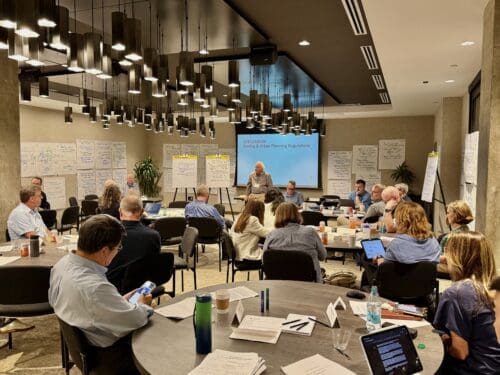
Engineering Change Lab – USA’s recent summit, Transforming the Regulatory System, focused on one important dimension of this shift – the regulatory system of the U.S. for infrastructure, energy, and the environment. Summit participants explored the wicked problem of transformative regulatory reform – going beyond small-scale tweaks and adjustments (common in many regulatory reform efforts) to thinking big about large-scale transformation and the role the engineering community could play leading those efforts.
Anchoring the group’s work on rethinking regulatory possibilities were two key ideas. The first idea stemmed from the summit’s opening evocation from evolutionary biologist David Sloane Wilson. Wilson noted that regulatory systems are fundamental to all living systems. Without regulation, living systems cannot survive. The U.S. regulatory system can be viewed as a cultural artifact within our living system, one that balances individual freedom and rights with the needs for collective governance.
Wilson observed that, from an evolutionary perspective, an over-emphasis on the former (selfishness) over the latter (altruism) can result in mal-adaptive behaviors and sub-optimum results for groups. Moving toward a more cooperative system should be a major objective for transformational efforts directed at our regulatory systems. As guidance for embarking on this type of transformational effort, Wilson pointed to a set of “core design principles” articulated by Nobel Prize winning economist Elinor Ostrom in her work on common pool resource management.
The second key idea was that understanding the path forward for transformation should start with acknowledging the past and the way the U.S. regulatory system has evolved into a complex, often mal-adaptive system. Group explorations at the start of the summit revealed that the last major shift in the trajectory of the U.S. regulatory system occurred in the 1970s, a period when many major environmental laws were passed (NEPA, Clean Water Act, Clean Air Act, Endangered Species Act, etc.).
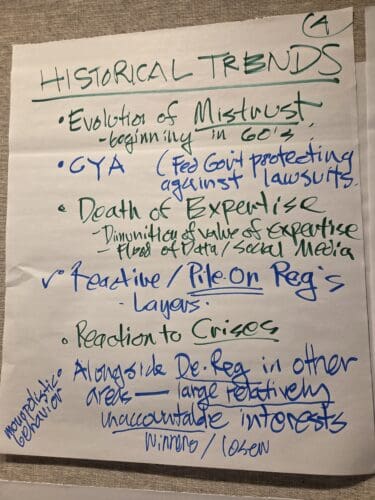
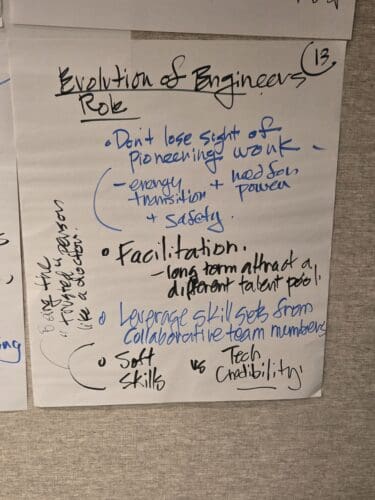
During that period, a relatively small group of dedicated lawyers asserted their leadership through public advocacy law firms and non-profits to transform the prior regulatory regime, which dated back to the New Deal in the 1930s. The primary vehicles for that transformation were the use of adversarial litigation, judicial proceedings, and case law to flesh out and memorialize regulatory processes. While these lawyers were leading the charge, the role of the engineering community faded and became largely reactive to initiatives led by others.
Over the last fifty years, the trajectory of our regulatory regime has stayed relatively steady, with subsequent amendments and case law simply adding layers and layers of additional policy and processes. This piling-on of regulations has greatly contributed to the degradation of our ability to build the infrastructure that society needs.
Participants observed that the disruptive environment of the last two years has set the stage for a possible dramatic leap toward a new regulatory regime, one potentially led by the engineering community. This jump could move the regulatory system away from the overwhelming dominance of Wang’s “lawyerly society.” Stewardship that the engineering community can offer society in this effort can balance the desire to build with the need for environmental protection and safety.
Reflections on the current state along with possibilities, potential directions, and required capabilities for this transformation were offered by a set of evocateurs / provocateurs during the summit.
- Rachel Levine of the Niskanen Center offered a presentation on the fragmented state of regulation of our electrical grid, which has resulted in delays, lack of coordination, and cost allocation disputes. Levine noted the leadership opportunities for the engineering community in fixing this broken system including optimizing communication with policy makers, learning the policy-making space, and engaging with affected communities early and often.
- Paul Heberling of The Nature Conservancy described the current “moment of opportunity” for the engineering community to contribute its expertise and credibility in balancing the need for environmental protection with the need for infrastructure and with shifting regulation from creating bureaucracy toward its fundamental purpose.
- Guru Madhavan of the National Academy of Engineering cited several historical examples of how innovation often arrives before governance systems are prepared, which can have catastrophic consequences. He stressed the importance of a systems engineering approach in reshaping our regulatory systems.
- Lisa Kammer of Weston Solutions highlighted the complex challenges of regulating PFAS – thousands of chemicals, uneven science, multiple release pathways, cross-program jurisdictions, and an unsettled regulatory landscape. She stressed innovation, cradle-to-cradle thinking, and shifting from static, compliance-focused permitting to adaptive permitting informed by real-time data collection and analysis.
- Beth Osborne, President and CEO of Smart Growth America, highlighted the housing availability and housing affordability crises in the U.S. and the regulatory barriers contributing to these crises – use restrictions, transportation policies, and permitting. She highlighted contradictions between transportation engineering and effective land use. She stressed the need for the engineering community to reform its practices from within and help address our housing crises by moving away from checklists to systems- and performance-based practices and policies.
All evocateur / provocateur presentations from the summit are available at the Knowledge Hub Page of ECL’s website.
To help move the group’s thinking into the future and deepen the group’s understanding of the role that the engineering community could play in change efforts, the summit design included exploration of two “speculative” case studies. The case studies illustrated the potential transformation of regulatory systems for two important issues – small modular nuclear reactors (SMR’s) and PFAS in data centers. The full case studies are available on the Knowledge Hub Page of ECL’s website. Highlights from the case study analyses are included below.
- Approaches to regulation were holistic rather than fragmented.
- New permitting and regulatory processes were enabled and supported by the leadership of engineers and the engineering community.
- Engineers used their systems thinking and systems engineering capacities to make major contributions to designing and implementing new permitting approaches.
- Early community and stakeholder engagement and collaboration were keys to success.
- Transparency with stakeholders throughout the entire process was critical to building trust.
- Innovative new technologies sped up the entire process, contributed to informed, effective stakeholder engagement, and fostered greater trust amongst participants.
- Creating new processes for permitting requires years of leadership work to build trust and create a common understanding of the need for infrastructure, such as SMR’s and data centers, and to instill confidence in the safety of these facilities.
To wrap up the summit, participants engaged in an extended dialogue centered on the question, “What do we think we are learning about the role that the engineering community can play in transforming the country’s regulatory system?” Key insights included:
- Holistic thinking is critical to success.
- Many in the engineering community think that regulatory systems are outside their area of responsibility. This does not align with our responsibility to society.
- We need to start internally by building a vision for regulatory reform in the engineering community — working through engineering organizations, internal coalitions and collaboration with other professionals.
- We can learn by imagining the future. How would we regulate the development of the moon or the cities of ASCE’s Future World Vision?
- Crisis creates opportunity. We are in the midst of a crisis with the current administration looking to significantly scale back regulatory systems. What happens if engineers are not at the table?
- We need to create a culture within engineering education that includes an expectation of active involvement in public service.
- Many sectors of our regulatory systems were designed for conditions that no longer exist.
An overriding theme of the summit was that the engineering community must lead the way in creating a vision of the future that captures the importance of addressing our critical infrastructure needs (e.g., transition to clean energy and the need for increased electrical power) and that paves the way to transforming the regulatory systems that are holding us back from this vision.
Just as a small group of attorneys disrupted the system in the 1970s, the engineering community can lead a new round of disruptive change in the 2020s.
Look for full documentation of the summit soon.