
Once upon a time in the not too distant future …
A group of leaders from across the engineering community gathered to celebrate the rapid growth and development of the community’s storytelling capacity in recent years.
They observed that practitioners and organizations have activated a previously latent capability for telling and using stories and narratives to better communicate and engage people, to build trust and relationships, and to understand the world, technology, and themselves.
The advent of this change has resulted in a significant expansion of the engineering community’s responsibilities in society beyond the technical. Once reticent engineers are now using stories in myriad ways.
As Leaders to …
- “Inspire the engineering imagination.” (Jenn Rossman)
- “Engage, motivate, align, direct, (and create) shared passion” and to deepen empathy for other people. (Eric Jolly)
- Communicate clearly and effectively, “in a simple way that people can understand.” (Sybil Derrible)
- Illuminate data and analytics.
- Transmit values, shape cultures, and change hearts and minds.
As Educators to …
- Question, challenge, and potentially transform many of the “myths that define engineering and what it can become.” (Woodrow Winchester)
- Inspire greater inquiry regarding ethical decision-making.
- Add nuance, complexity and meaning to the objective mindset that dominates engineering education and practice. (Rob Martello)
- Help engineering students develop their “narrative identities … the plot of their lives.” (Jon Adler)
As Individuals to …
- “Pay attention to the world in a new, deeper way.” (Emanuelle Burton)
- Become who they truly are as people, leaders, and practitioners.
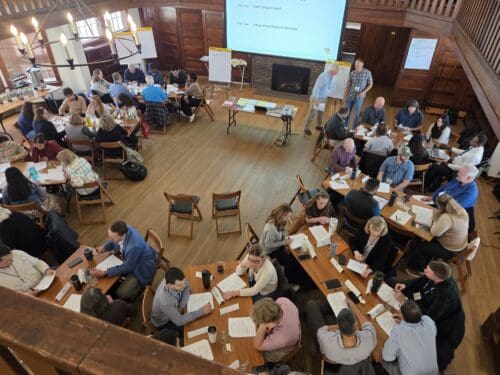
This type of surge in storytelling and its benefits was the intended outcome of The Power of Storytelling in Engineering Summit convened by the Engineering Change Lab – USA (ECL) on November 10 & 11, 2026. At the summit, a diverse group of 60 participants gathered at the Colorado Chautauqua in Boulder, Colorado to examine the power of storytelling, to develop their own personal storytelling skills, and to set a potential path forward for the engineering community to better integrate storytelling into its work. A brief recap of that summit experience follows.
Early on during the summit, attendees noted that the history of the engineering community has always been full of stories – stories of amazing accomplishments that have improved quality of life across the globe; often hidden, untold stories of how our work has sometimes negatively impacted people and communities (particularly the disadvantaged segments of society); and traditional stories (or myths) that engineers tell themselves about the nature of their work and their role in society.
To advance the engineering community’s contributions to the challenges of the 21st century, practitioners will need to both listen to the stories of those impacted by our work and tell new types of stories about the changes needed to create an abundant future for all.
The summit’s exploration was enriched by contributions from a remarkable set of evocateurs and innovators in the use of storytelling within the engineering community.
Jenn Rossman, Dean of Engineering at Lafayette College, used the pursuit of space travel to illustrate how positive stories can inspire the engineering imagination as well as frame moral choices faced by the engineering community. She cautioned that care needs to be exercised so that storytellers don’t, either intentionally or inadvertently, distort, bias, or hide critical elements of the narrative.
Eric Jolly, Past President and CEO of Saint Paul & Minnesota Foundation, offered that stories can engage, motivate, direct a course of action, and create shared passion. He stressed that we all have stories, and we need to frame our stories so others can find insight. He used personal stories to demonstrate the evocative power of narratives, stimulating emotional responses and imparting significant lessons to the listener.
Woodrow Winchester, Executive Director, Texas Engineering Executive Education at the University of Texas at Austin, used his new “Unmasking Engineering” card deck to encourage reflection at the level of the entire engineering community. He described how the traditional or inherited stories/myths of engineering are often implicit and pervasive; how they disappear into the background but still exert a force shaping actions and decisions. Transforming engineering requires transforming these stories.
Emmanuelle Burton, Senior Lecturer at the University of Illinois Chicago, School of Computer Science, illustrated how using fiction and listening to stories can help surface and facilitate the exploration of ethical dilemmas that members of the engineering community face. She counseled that taking a “whole person” approach to ethical inquiry, looking beyond the normal boundaries of professional ethics, can lead to a deeper understanding of the values embedded in technologies and held within ourselves.
Jonathan Adler and Rob Martello, faculty at the Olin College of Engineering, engaged in a conversation with ECL Board of Directors member Alison Wood. Rob emphasized how storytelling is at the core of Olin’s philosophy – integrating humanities, arts, and social sciences into engineering. Regarding the relevance of storytelling in engineering education, Jon emphasized that knowing how to tell a story about who you are is an important element of personal development. Rob stressed how stories add nuance and complexity and expand on the objective mindset of students. In describing how they help young people become more comfortable with storytelling, Rob emphasized how stories are a human adaptation and that everyone’s stories are needed; Jon emphasized the need to debunk the idea of the perfect story.
Sybil Derrible, Professor in Urban Engineering at University of Illinois Chicago, described his experience in the use of storytelling and narratives to communicate regarding engineering and infrastructure. Through this work, he has mastered the art of explaining complex concepts in simple terms. He offered suggestions on learning this craft including finding your voice, making sure that people are at the center of the story, and the importance of practice.
The overall flow of the summit complemented the inspiration and wisdom provided by these evocateurs with individual learning and group explorations designed to both understand and codify the power of stories in engineering and enhance personal story reading and storytelling skills.
- Participants reflected on learned lessons from exceptional storytellers in their own lives and recognized that in many ways we already have the teachers we need to become great storytellers.
- They catalogued both the uses and benefits of stories, storytelling, and narratives.
- The group explored arcs, archetypes, and other patterns that can be used to structure stories and narratives.
- And, individuals enhanced their personal storytelling skills, spotting potential stories and preparing and then practicing telling them with the support of peer coaches.
Summit work also set up a future learning agenda with respect to stories and storytelling in engineering. Future inquiry and learning could focus on …
- Choosing the best platform for educating the public and elected officials.
- Using different forms of media (Substack, Podcasts, YouTube, TikTok, etc.).
- Alternative forms of storytelling (including music, art, and performance).
- Interactive and immersive experiences.
- Collaborative storytelling.
- AI and storytelling.
- And, using stories to transfer knowledge and wisdom across generations.
A final dialogue provided a synthesis of key learnings form the summit, including:
- The success of our work often languishes as an untold story. Engineers need to use stories to help make those achievements visible.
- It is the engineer community’s job to paint the future we, our communities, and society wants. Stories can serve as a primary means of fulfilling that responsibility.
- Engineers are uniquely qualified to become advocates for the common good through the stories we create and tell.
- We can marvel about how easy and natural it is for children to tell stories. What could they teach us if we were willing to listen and learn from them?
- Good storytellers…
- Are vulnerable.
- Invite others into their story.
- Are willing to bring in emotions as essential elements of storytelling.
- Are not driven by ego.
- Are willing to practice, practice, practice.
- We must be willing to examine who and what we seek to inspire as well as who might be left out of the story.
- As humans, we all have stories to tell. We need to frame our stories so others can find insight from them.
- Mentors play a critical role in our journeys and in our stories; we must recognize the important contributions of our mentors and commit to mentor others.
- The engineering community often operates based on inherited stories/myths about our role and our work. Transforming engineering requires transforming these stories/myths.
- Engineering stories do not have to be technical reports.
- Empathy has been construed as a weakness when it is really a superpower. AI cannot replace empathy.
- Great leaders are great storytellers who know themselves and commit to reflection on their own journeys.
- If we do not tell our story, someone else will.
Look for the complete story of this ECL summit soon.