Summit Wrap-Up, Part 2
For this summit, we asked six thought leaders to play the role of “evocateur,” to help call forth and breathe life into our collective imagining of a future vision, goals, and strategies for the engineering community. A summary of those evocations as well as perspectives shared by the five members of our student panel are provided below.
Ed Finn, Director of the Center for Science and the Imagination at Arizona State University
Ed Finn evoked the power of storytelling, image-based worldbuilding, and speculative fiction to inspire collective imagination. Drawing on a recent article, “Step Into the Free and Infinite Laboratory of the Mind,” (https://issues.org/science-fiction-policy-tool-finn/), Finn observed that collaborative narratives, such as good science fiction, can play a primary role in helping science and society reach beyond current configurations toward positive transformational futures.
The mission (Igniting Collective Imagination for a Better Future) and the work of the Center for Science and the Imagination that Finn founded at ASU (https://csi.asu.edu) reflects this belief and commitment. Finn noted that imagination is a fundamental human capacity and that collective imagination is a team sport.
Too often, we ignore this capacity, particularly with respect to the future. “We teach history, not the future.” Rather than reinforcing the status quo, the engineering community needs to learn to use it’s ability to imagine and tell stories of the future to inform, to guide, to inspire, and to motivate practitioners, policy makers, and the public to consider positive transformative possibilities and inspire communities of care.
He concluded by setting the stage for the work of this ECL summit, envisioning a new aspirational future and path forward for the engineering community, with a quote from Buckminster Fuller.
“You never change things by fighting the existing reality. To change things, build a new model that makes the existing model obsolete.” – Buckminster Fuller
What new models might we imagine for the engineering community? What stories can we tell about this aspirational future?
Link to Ed Finn’s Presentation Slides
Rochelle Grayson, Founder, Mosaic Accelerator and Co-Founder, Circles of AI
Uncertainty about artificial intelligence (AI) and its impact is a major driver of the future shock being experienced by the engineering community in 2025 according to Rochelle Grayson, a veteran leader of tech startups and incubator spaces. Keeping humans in command of this advanced technology is a major challenge as AI transforms the world of engineering.
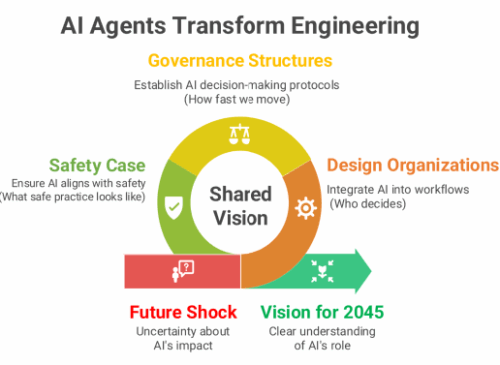
Left unattended, AI agents operate with a high degree of autonomy. She points out that this tendency toward autonomy needs to be balanced by human oversight, or “Human in Command,” by engineers designing the decision rights and escalation paths for AI.
Grayson pointed to the work of Tey Bannerman and his “Human-in-the-Loop” framework (https://teybannerman.com/images/human-in-the-loop-framework-by-tey-bannerman.pdf) as a particularly helpful tool for thinking through this balancing act for engineers. Bannerman’s framework is structured around two key questions to guide users in identifying the role they should play when deploying or using different AI technologies and applications:
- What are you optimizing for?
- What’s at stake?
To move from Bannerman’s Human-in-the-Loop approach toward an even more robust Human in Command stance, Grayson emphasizes the need for engineering to “own the loop,” beginning with a clear determination of “who decides” when the system is designed. Grayson stressed that “human in command” does not necessitate micro-managing policies.
The adoption of AI in engineering practice will require a major shake-up in the role of junior engineers and paths for advancement within engineering organizations according to Grayson. One possibility she suggests is the adoption of a medical residency model for engineers. A residency model for AI-enabled engineering would focus on being clear on “who is entrusted to do what, under which supervision?” Systems engineers would assume the role of “attending physicians,” orchestrating and supervising the work of engineers as they move up from junior to senior domain knowledge and from low to high levels of autonomy in the use of AI agents.
Finally, Grayson left the group with three evocative challenges.
- Which modes of oversight would you retire in 2026? Which would you double down on?
- Where is the biggest chosen scarcity in your organization – permits, procurement, risk, or talent? And how might AI impact that?
- Up-Wing Bet – name one technology or process you would accelerate next year.
Link to Rochelle Grayson’s Presentation Slides
Jenna Carpenter, Dean, School of Engineering, Campbell University and Past President and Fellow of ASEE
Jenna Carpenter began her evocation by observing that higher education has, in the last five years, faced “an almost continual stream of stress” including the pandemic, the decline in college-going among high-school graduates, and the erosion of support and respect for science, fact, and truth in our society. This year, the simultaneous arrival of rapidly evolving AI, unprecedented and repeated political upheavals impacting higher education, and the arrival of the long foretold demographic cliff in high school graduates has significantly disrupted and unmoored engineering education institutions of all sizes and types across the country.
She argued, however, that amid the gloom and doom, “we should take advantage of this opportunity provided by the unmooring or unfreezing of the higher education system.”
To illustrate the critical nature of this pivot point and the opportunity it presents, Carpenter reminded participants of the scene from the movie Apollo 13, “where Tom Hanks’ character, Astronaut Jim Lovell, has to do an unplanned manual burn for a wild and erratic 39 seconds in order to make sure the returning lunar module hits the earth’s atmosphere at the right angle, to avoid either bouncing off into space or burning up upon re-entry.”
Carpenter observed that “we have already entered our 39-second window in higher education, which means that we may not have that much time left to make needed changes. So, what we do in the short time span that we have left matters, because when we emerge on the other side, the direction we are pointing – just like the Apollo 13 spaceship – will be the one in which we are headed, right or wrong. That means we must decide pretty fast what we want (or ought) to do and put the things in place we need to help us realize those changes as soon as possible.”
Possibilities for a new trajectory for engineering education are already emerging including the NSF-funded American Society for Engineering Education Mindset Project which Gary Bertoline will describe in his evocation and the work of a set of innovative programs and universities such as the engineering program at Campbell University.
Carpenter challenged the group, “What we cannot do (in the face of this wave of disruptive change) is do what we often do … we cannot ignore our present circumstances, bury our heads, wait for the chaos to pass, and hope for the best. That will almost surely be a prescription for failure. But if we work together, remain positive in the face of chaos, figure out successful strategies and approaches, and apply those in our own contexts (not unlike what we did during the pandemic), then we have a chance to create a new vision for engineering education – before everything refreezes into a new normal – a chance to develop and implement strategies that will equip us to achieve new goals and aspirations – along with things we probably should have been doing all along.”
Link to Full Text of Jenna Carpenter’s Evocation
Jerry Buckwalter, Strategy Essentials
We are too often surprised by disruptive changes that we experience observed Jerry Buckwalter at the start of his evocation. This has been particularly true for the engineering community in 2025. To better anticipate and prepare for these types of inevitable surprises, change agents within the engineering community need to significantly up their efforts with respect to strategic planning and systems thinking.
A new type of storytelling and strategic thinking called worldbuilding should play a central role in these efforts, according to Buckwalter. Worldbuilding involves the creation of detailed, imaginary worlds that often serve as foundational exercises for the best science fiction (such as the creation of the futuristic setting of the movie “Minority Report”).
Worldbuilding can provide a primary means for changing professional mindsets and cultures. These stories of the future can allow people to explore possible futures, imagine changes necessary today to reach those future states, and mobilize and motivate people to act today to better prepare for the future they will ultimately face.
ASCE’s Future World Vision initiative, begun in 2018, serves as a primary example of this potential. ASCE’s worldbuilding effort culminated in an incredibly rich and detailed set of “cities of the future” that are available for the engineering community and broader public to engage with and learn from.
Buckwalter observed that the creative work behind these stories led to early consideration of many of the drivers of change currently surprising the engineering community, including the impact of advanced technologies such as AI and the consequences of the nexus of exponentially increasing water and energy demands in urban environments.
Future World Vision narratives, such as MegaCity 2070, and a derived set of transformational imperatives for engineering are now providing a roadmap and test bed for significant change efforts being launched across the engineering and design community.
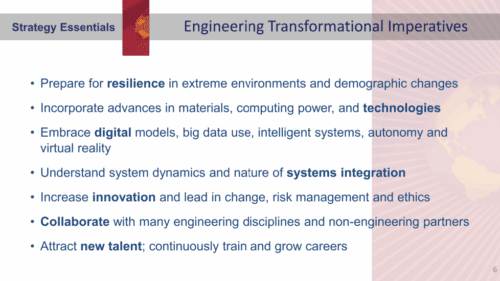
Buckwalter pointed out universities, government organizations, and NGO’s that are creating new engineering methodologies, novel infrastructure solutions, and innovative financing models based on these narratives and transformational imperatives, including:
- A DARPA and NASA exploration of what is required to build on the moon,
- An initiative by New York University to create a global, applied, cross-disciplinary, urban engineering program to address rapid urbanization around the globe.
- ARES Institute’s efforts to create a better infrastructure financing model to unlock private capital.
Buckwalter encouraged engineering community participation with global and domestic entities, such as the United Nations and the Center for Public Policy Innovation, so that our voice is heard in the public policy decision-making domain.
Link to Jerry Buckwalter’s Presentation Slides
Bob Gilbert, Civil, Environmental & Architectural Engineering Department, University of Texas, Austin
Jerry Buckwalter, Strategy Essentials
The current effort being led by Bob Gilbert to transform how his Civil, Architectural & Environmental Engineering (CAEE) Department at UT Austin approaches engineering education is a clear exemplar of the type of change that Buckwalter is advocating.
The two of them have been collaborating since 2018 when Gilbert first learned about the ASCE Future World Vision initiative. Gilbert quickly grasped the potential of the transformational imperatives and began thinking about how they might be applied within the CAEE department.
With the support of the Dean of the College of Engineering, Gilbert assembled a group to explore this potential and create a compelling story about what this change could look like. That story was powerful enough to attract the interest of Fariborz Maseeh, who consequently made a major donation to fund this transformational initiative.
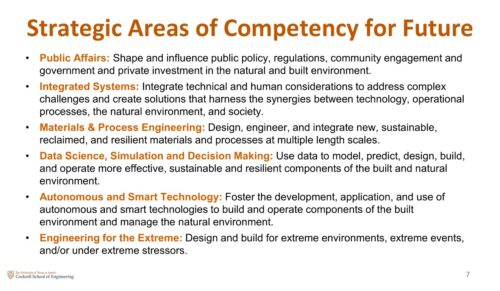
Next, Gilbert launched a strategic planning effort with a team of faculty, students, staff, and outside consultants and stakeholders. A new vision and set of strategies were developed to guide this transformation and prepare students (and the profession) for the future. The plan included the identification of strategic areas of competency for the future, a complete curriculum overhaul, the reorganization of the department, initiation of an innovation prize program, and plans for a disruptive innovation symposium in 2026.
This transformation is just getting started, but Gilbert notes that the Dean of the College already believes that the CAEE initiative represents a pilot for all UT Austin engineering.
Buckwalter followed up Gilbert exposition of the change effort within CAEE by observing that, “We like to think we succeed based on our capability to instruct, but we don’t. We succeed based on generating the outcomes our graduates need for the next 40 years.”
As we consider the long-term future, Buckwalter offered a set of key questions to consider:
- What is the overall job the graduate will try to get done, and how is it different than today?
- How will their employment or business context affect their ability to succeed – access to resources, barriers, cause of suboptimal results?
- What resources (products, services, and finances) will they be integrating, and do they collectively facilitate or hinder success?
- How can all these resources be enhanced to improve success?
The answers to these questions, he noted, will be slightly different for each university, but the necessary strategic competencies of an “outcome-based mindset, systems thinking, and a future-based perspective” will be the same for all graduates.
Link to Bob Gilbert & Jerry Buckwalter’s Presentation Slides
Gary Bertoline, NAE Engineering Mindset Project and Purdue University
We are at a crossroads in engineering education where we can either continue to incrementally improve a system handed to us by our past or create a movement to design a new system that addresses the challenges we face now and in the future.” The Engineering Mindset Report, ASEE & NAE, draft 2024
Gary Bertoline began his evocation by asking the group to “name the mountain and prophet who offered the stone tablets to us with the commandments that established our higher education system.”
In answer to his question, he observed that our higher education system was largely developed in the early 1900’s and that the Grinter Report of 1955 and Sputnik (1957) were the catalysts for the last major change in engineering education. For over seventy years engineering education has been largely frozen in place with a fixed mindset that is now seriously out of sync with the demands of the 21st Century.
Taking a cue from the Stanford-based psychologist Carol Dweck, he argued that this fixed mindset (where abilities and intelligence are static constraints) needs to be replaced by a “growth mindset” for engineering education that embraces “the idea that abilities and intelligence can be developed, leading to a more fulfilling and successful engineering program and graduates.”
This mindset shift is the heart of a national effort to redefine undergraduate engineering education for the 21st Century initiated by ASEE and NAE and funded by the NSF. The effort aims to make a step-function change in engineering education and “to replace exclusionary traditions with inclusive, flexible, student-centered systems.” The Engineering Mindset Report challenges current mindsets around mathematics and science, curricula, and the way engineering faculty teach and how they assign and evaluate engineering problems. It also confronts previously sacrosanct elements of higher education such as credit hours.
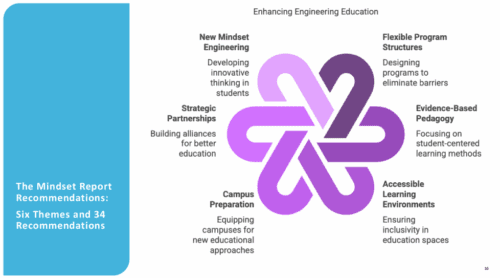
The mindset initiative proposed “to develop a roadmap for a flexible, human-centered, accessible, and multi-path engineering curriculum that fosters a growth mindset and prepares graduates to thrive in an unpredictable future.” The final report sets out six themes for enhancing engineering education along with 34 recommendations for implementation.
The developers of this report hope “to start a movement with strategic partners to create an innovative engineering education system that empowers every student, regardless of their background, to succeed and thrive.” Bertoline noted that “great engineering educators design the learning environment as carefully as they design systems.”
Bertoline concluded by observing that this is our “Sputnik Moment.” It is our turn to step forward to leadership in society, understanding the value that engineering and design provides for the future of humanity.

How will the engineering community respond to this transformational moment?
Link to Gary Bertoline’s Presentation Slides
Student Panel
- Taimoor Anwar, Petrochemical Engineering, UT Austin
- Audrey Baker, Architectural Engineering / Structural, UT Austin
- Maddie Moshaver, Civil / Transportation, UT Austin
- Harper Minor, MBA, UT Austin (Civil Engineering Degree from Georgia Tech)
- Sophia Shelton, Civil / Structural, UT Austin
As part of our deep dive into the disruptions of 2025 and the future of engineering, five students agreed to share their perspectives about the challenges currently facing the engineering community, thoughts about their generation of engineering students, and their experiences in school.
As you look forward to your graduation, what do you think are the top three challenges confronting the engineering community?
- Sustainability and the transition to sustainable energy at a time when demands for energy are increasing.
- Sustainability is gaining traction in the private sector, but innovation can be counter to sustainability goals. Are we rushing new tech in energy which may create bigger implications down the road?
- Readily available AI and its growing impact on education and practice.
- Because AI requires tremendous resources, are we responsible for the way we use it? Will we be able to maintain all that is under development?
How is AI impacting your educational experience? Where have you seen its most positive impacts / problematic impacts?
- Concern about the ethical use of AI and maintaining our integrity as students.
- Over reliance on technology, not understanding the basics.
- AI is a good tool but worried about students over-relying on it. AI limits critical thinking skills which we need to make judgment calls.
- AI is impacting the level of trust between students and professors.
- Engineering programs are falling short in preparing students for the workforce.
- We are losing our ability to interact with each other with work from home, AI, etc. The value of meeting together in person seems to be lost. This will have work environment impacts.
How are students using AI?
- To get started on how to solve a problem when help isn’t available.
- Improving emails and other written documents.
- Connecting notes with learning objectives to help streamline test preparation.
What would you say are distinguishing characteristics of your generation of engineering students / young practitioners that employers should be aware of? How might your generation be different than previous generations?
- In the workplace, when we are working on projects across the company, often with hybrid teams, we struggle with project “ownership.” We lose connection to our projects and our communities.
- Many students seem to be missing a passion for the learning. They are just going through the steps.
- We are tech-savvy and more comfortable with, and adaptable to, new technologies.
- We use new tech in our course work and know how to apply it.
- We pick up software applications very quickly.
- We are more casual and lack an understanding of what professionalism looks like, including in text and speech (specifically emails).
- Boundaries around work/life balance are important to us. All the sharing via social media means that we are more aware and are standing up for our work/life balance.
How has your educational experience helped you to prepare to enter the profession? What have been particularly impactful experiences in your college journey in terms of preparing to enter the profession?
- Real world project-based learning and project experience is much more beneficial.
- Would love to see more project-based learning before you get to the upper-level classes. Would help build that passion for the work.
- Research with different professors helps to deepen learning.
- Education combined with internships is the best preparation.
- Hands on internships are super enriching.
- Even internships outside of where you end up are valuable.
What makes for a good internship experience?
- See the business side of engineering.
- Understanding of full life cycle of a project.
- Attend client meetings.
- Open to questions about the future so we can learn more than the work at hand.
- Research and design studio (multi-discipline) experiences help to prepare for the choices to come (classes to take and work options to pursue).
- Civil engineering is broad and involves many different stakeholders. A favorite class is Civil Engineering systems where they talk about stakeholders, technology and cost.
- State of the art labs provide great hands-on experiences but sometimes we are just “checking the box” instead of really learning and taking the time to get all we can out of the work.
Although still relatively high, engineers, like many professions, have experienced a loss of trust with the public . What could members of the engineering community do to help shore up a trusted relationship with society?
- Lack of communication impacts the public’s trust in us. Confusion creates fear.
- Will AI impact public trust? Getting it done versus thinking about the how and why. Does comfort with tech fuel this situation? Licensure will need to evolve, but not sure what that looks like.
- Failures and problems are blown up in the news, impacting public trust. Answers are not immediate. The public doesn’t understand why it takes time. This can cause speculation and create concerns.
- Those responsible for designs (sealing) – do they understand how tech was used and how we get to the design?
- Give younger engineers space to learn the whys and the how (versus focusing on keeping them utilized/billable).
Thinking about the path forward for the engineering community and given the disruptions being experienced today, what advice or counsel would you offer engineering managers/leaders?
- Be patient with us, we want to learn.
- Communication is critical.
- Find a place/role for young engineers in implementing tech.
- Share experiences to help fuel the passion.
- Encourage diversity of perspective from other fields.
__________________________________________________________________________
These evocations and remarks by the student panel inspired the collective inquiry and visioning that emerged during Engineering Change Lab – USA’s (ECL) latest summit, Beyond Disruption: Pioneering a New Path for the Engineering Community. Using these insights, fifty leaders from the engineering community mapped the current context for the engineering community, assessed it strengths, weaknesses, and major opportunities available in 2025, and envisioned aspirational goals, a new path forward, and a set of strategies that will enable the engineering community to continue to fulfill its critical role in society.
In the third part of this series of reports on the summit, we will communicate more about strategic and scenario thinking that emerged over the course of the summit as well as potential next steps that were identified for ECL. Stay tuned.